 English
 Chinese
“Shake-to-Use” Mercury-Free Glass Thermometers Are Here!
source:本站 Number of views:48 time
From household medicine cabinets to medical institutions, mercury thermometers were once the most familiar temperature-measuring tools—accurate, inexpensive, and easy to operate. However, behind this convenience lies a health and environmental risk that cannot be ignored. With the nationwide ban on the production of mercury thermometers taking effect on January 1, 2026, a safer and more environmentally friendly era of temperature measurement is arriving. Modern technologies have provided mature and reliable mercury-free alternatives, among which Galinstan (an alloy composed of gallium, indium, and tin) thermometers are entering our lives with the familiar “shake-to-use” experience.
I. Hazards of Mercury—Concerning Human Health and the Ecological Environment
Mercury is a global pollutant with persistence, bioaccumulative properties, and long-range transport potential, and has been identified by the World Health Organization (WHO) as one of the top ten chemicals of major public health concern. When a mercury thermometer breaks during use or is not properly managed at the end of its life cycle, the elemental mercury it contains may be released into the environment. Under anaerobic conditions, this mercury can be transformed by microorganisms into highly toxic methylmercury. Methylmercury readily accumulates in aquatic food chains and ultimately enters the human body through dietary intake, impairing the development of the nervous system and posing significant risks to pregnant women, fetuses, and children. In addition, environmental releases of mercury can cause long-term contamination of soil and water bodies. Therefore, phasing out mercury thermometers and sphygmomanometers in the medical sector and replacing them with safe and reliable mercury-free products is a fundamental measure to control health and environmental risks at the source.
II. Minamata Convention on Mercury—International Treaty and China’s Actions
Background of the Convention:
The Minamata Convention on Mercury (hereinafter referred to as “the Convention”) is named after the methylmercury pollution incident that occurred in Minamata, Japan, in the 1950s, serving as a warning to the world about the catastrophic consequences of mercury pollution. On January 19, 2013, the United Nations Environment Programme adopted the Convention, establishing the world’s first comprehensive international legal framework for the control of mercury pollution. It provides systematic provisions for the production and use of mercury-containing products, mercury emission control, and waste management.
China’s Implementation Actions:
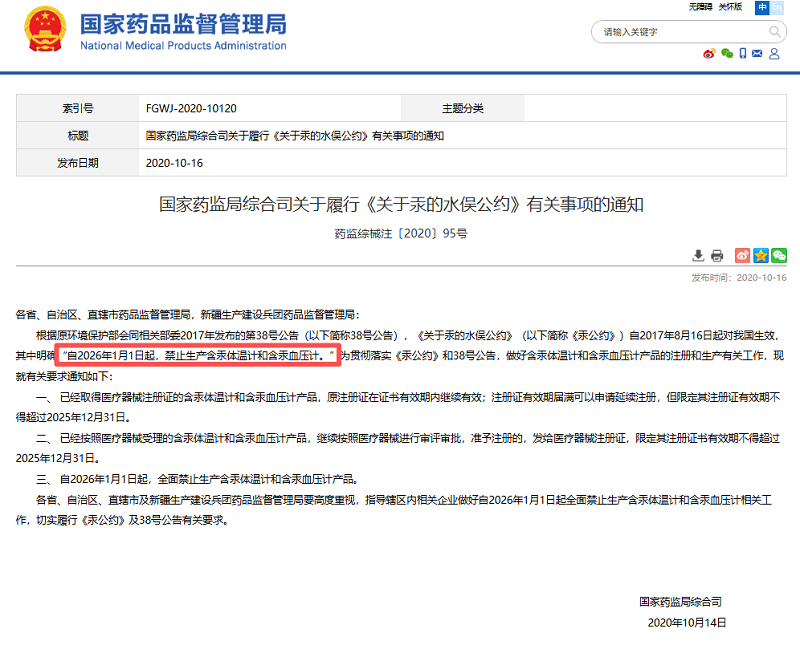
The Convention has been in force in China since August 16, 2017. According to the notice issued by the General Office of the National Medical Products Administration on matters related to the implementation of the Minamata Convention on Mercury, China will fully prohibit the production of mercury thermometers and mercury sphygmomanometers starting January 1, 2026. This milestone marks a critical phase in China’s mercury reduction efforts in the medical sector.
III. Mercury-Free Alternatives—Galinstan Thermometers Stand Out
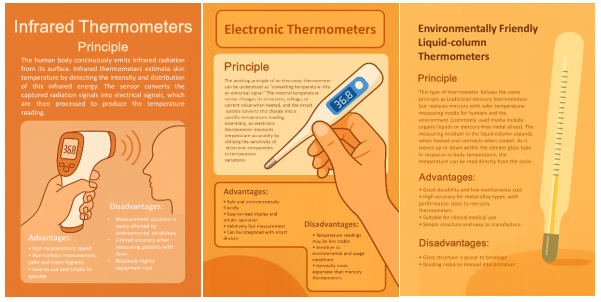
After the production of mercury thermometers is banned, how can we accurately measure body temperature? Currently, mainstream options include electronic thermometers, infrared thermometers, and environmentally friendly liquid-column thermometers (such as Galinstan thermometers). Each has its strengths and limitations:
· Electronic thermometers: fast measurement and easy-to-read results, but stability may be affected by environmental conditions;
· Infrared thermometers: non-contact, convenient, and hygienic, but accuracy may be influenced by external factors;
· Environmentally friendly liquid-column thermometers: preserve traditional usage habits and offer stable readings suitable for clinical use, though the glass casing requires careful handling.
Among the various alternatives, Galinstan thermometers have emerged as a standout solution. Using a liquid alloy composed of gallium, indium, and tin as the temperature-measuring medium, they are non-toxic, environmentally friendly, and possess thermal expansion properties very similar to mercury. They retain the accuracy and durability of traditional glass thermometers while completely eliminating the hazards associated with mercury. When in use, a simple shake is all that is needed to measure temperature accurately just as before, ensuring seamless continuity with familiar practices in both household and clinical settings.
DONG E E-HUA MEDICAL TECHNOLOGY CO., LTD. began investing in the research and development of Galinstan thermometers at an early stage and successfully obtained an invention patent in 2008, becoming a benchmark enterprise in the mercury-free transition of China’s medical device industry.
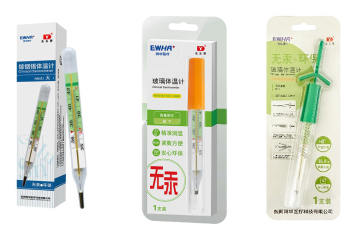
The commonly available mercury-free glass thermometers on the market; the “Green Wing” casing (far right) features an assist-shake design.
IV. Demonstration Projects Driving Progress—GEF Support for China’s Mercury-Free Transition
To advance the implementation of the Minamata Convention on Mercury, the Foreign Environmental Cooperation Center of the Ministry of Ecology and Environment and the United Nations Development Programme (UNDP) jointly implemented the Global Environment Facility (GEF) project titled “Demonstration of production phase-out of mercury-containing medical thermometers and sphygmomanometers and promoting the application of mercury-free alternatives in medical facilities in China”. By carrying out demonstration activities on the phase-out and transformation of mercury thermometer and mercury sphygmomanometer production in enterprises, as well as promoting the application of mercury-free products in medical institutions, this project aims to advance the replacement of mercury thermometers and mercury sphygmomanometers in China, reduce the use and release of mercury, and support the achievement of China’s obligations under the Minamata Convention.
Leveraging its extensive experience in the fields of energy and environment, public health, and green technologies, the Energy and Environmental Development Research Center (EED) has provided full-cycle management consulting services for the benchmark enterprise DONG E E-HUA MEDICAL TECHNOLOGY CO., LTD. under this GEF project, assisting the company in systematically advancing the phase-out of mercury-containing products and the transition to mercury-free technologies: Project management and alignment with international standards — EED delivered professional project management services, assisting the enterprise in strictly following international project requirements and ensuring that project outputs meet the standards of the Global Environment Facility; Technical achievement evaluation and certification — EED supported the company’s core product, the Galinstan thermometer, in successfully completing the scientific and technological achievement evaluation organized by the All-China Environment Federation. Owing to its superior environmental performance and temperature measurement accuracy, the product received a certification of “internationally advanced”, establishing a technical foundation for market adoption and international promotion.
With the 2026 nationwide production ban approaching, a safer and more environmentally friendly era of temperature measurement is within reach. This is not merely the implementation of a policy, but a profound transformation grounded in science, centered on health, and oriented toward the future. By bidding farewell to mercury thermometers and embracing mercury-free alternatives, we are taking a solid and essential step toward safeguarding human health and protecting our planet.